People’s Choice, Door Prizes and 50/50 Draws: What’s the Difference?

· 14 min read
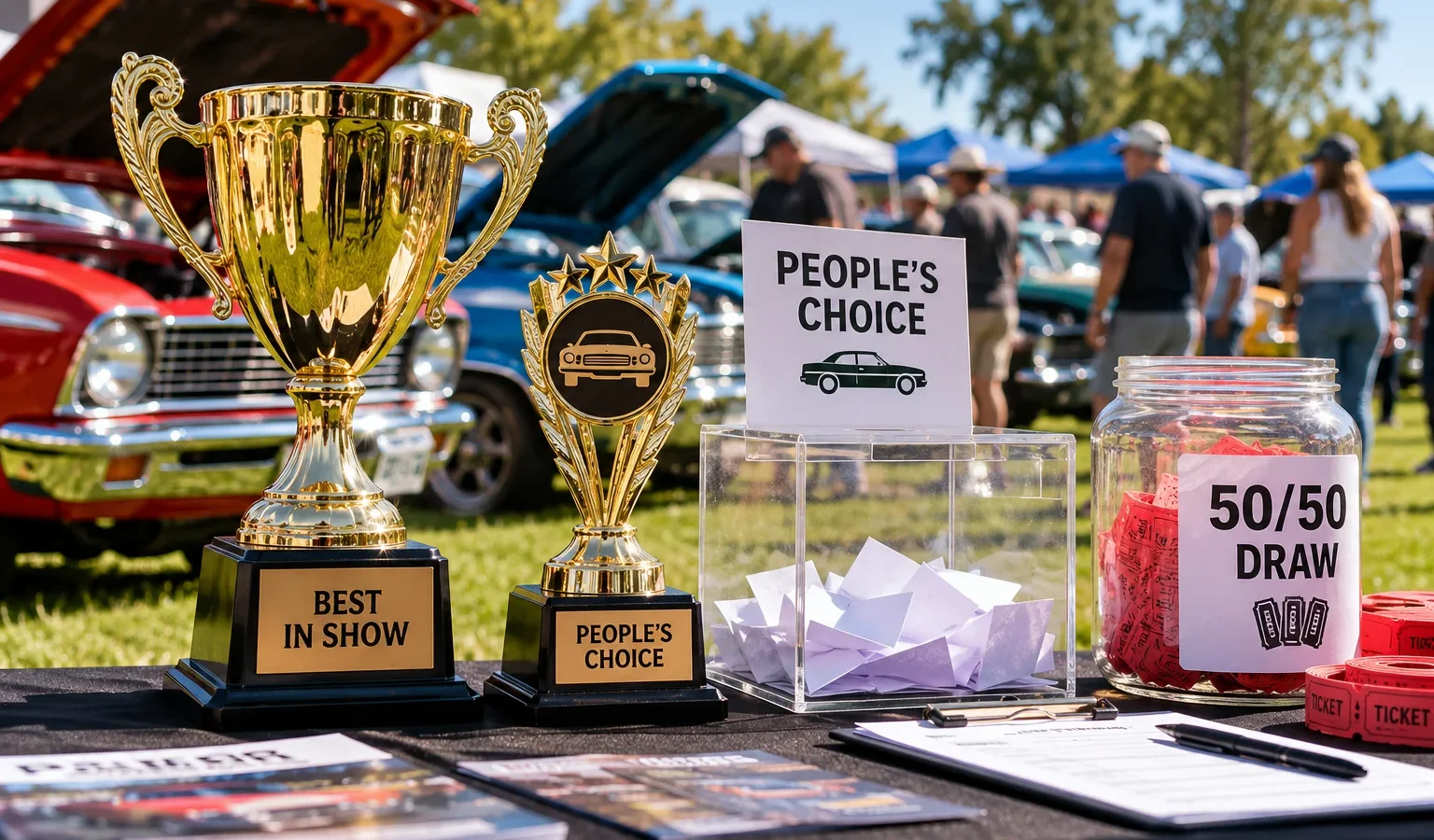
A show & shine might hand out trophies for Best in Show, invite spectators to vote for People’s Choice and finish the afternoon with a donated prize or 50/50 draw. They all involve winners, but they don’t work the same way — and treating them as interchangeable can cause problems for organizers.
The difference comes down to how winners are selected, who can participate and whether money changes hands. For Canadian community car shows, those distinctions matter for fairness, public expectations and, in the case of fundraising raffles, provincial licensing requirements.
Not every car show prize is awarded the same way#
A judged award recognizes something about a vehicle. People’s Choice reflects audience preference. A random draw selects a winner without evaluating the quality of their car — or requiring them to own one.
Here’s how the four formats compare.
| Format | How the winner is selected | Typical purpose |
|---|---|---|
| Judges’ Choice | Vehicles are scored against published criteria | Recognize condition, restoration or workmanship |
| People’s Choice | Eligible spectators or entrants cast votes | Recognize the crowd favourite |
| Free door prize | An eligible participant is selected randomly under stated rules | Encourage participation and add entertainment |
| Paid 50/50 draw | A winner is selected through an authorized, licensed percentage raffle | Raise funds for an eligible purpose |
A 50/50 draw differs from a regular merchandise raffle because the cash prize is calculated as a percentage of eligible ticket sales. In a conventional 50/50 arrangement, half the ticket revenue forms the prize and the other half is allocated according to the approved fundraising arrangements.
That distinction is more than organizational. Paid raffles are regulated gambling activities, while vehicle judging and ordinary public voting generally operate under the event’s competition rules.
A free random giveaway may avoid certain gambling-licensing requirements, but that doesn’t automatically make it exempt from every applicable law. The entry conditions, promotional purpose and way the prize is awarded still matter.
Awards recognize cars; draws select participants#
The simplest way to keep these activities straight is to ask what the winner has actually earned — or whether earning anything is part of the selection process.
Judges’ Choice depends on published criteria#
Judged awards assess vehicles against established expectations.
A restored classic might receive high marks for authenticity, paint condition and attention to detail. A heavily modified hot rod could be recognized for fabrication quality, finish and overall execution.
The results should follow a documented scoring process rather than a judge’s personal attachment to a particular model.
Best in Show requires an especially clear definition. Some events select the highest-scoring eligible vehicle; others conduct a separate assessment among class winners. Neither approach should be improvised after judging finishes.
Organizers also need to establish whether the same vehicle can win both its class and Best in Show.
People’s Choice reflects audience preference#
A People’s Choice trophy answers a different question: which vehicle did voters enjoy most?
That might be an immaculate restoration, a custom truck or a daily driver with an unusual story. Spectators don’t necessarily evaluate vehicles using the same standards as judges.
A memorable display and a friendly conversation with the owner may influence someone’s vote just as much as flawless paintwork.
This doesn’t make People’s Choice less meaningful. It makes the award a measure of audience preference rather than technical quality.
Voting eligibility should be published in advance. Decide whether owners may vote, whether votes are limited to people attending the show and how duplicate submissions will be handled.
Random prizes don’t measure vehicle quality#
A door prize gives someone an opportunity to win without having the best-looking car in the field.
Consider a local business donating a detailing kit for an afternoon giveaway. The organizer might allow eligible spectators to enter at no cost, then randomly select a winner at a scheduled time.
That winner hasn’t beaten anyone in a vehicle competition. They’ve been selected from the eligible entries.
For this reason, door prizes should be identified separately from judged trophies. Calling a random giveaway an award can confuse entrants who assume every winner has been evaluated.
It also helps to keep prizes for visitors separate from recognition for participating owners. A family attending as spectators may enjoy a door-prize drawing without having any interest in the judging results.
Why voting and random selection feel different#
Judging, voting and random selection all create anticipation, but the person participating has a different relationship with the result.
A judge applies criteria. A voter expresses a preference. Someone entering a random draw accepts that the outcome is determined by chance under the draw’s rules.
Understanding those differences helps organizers avoid promising more control or influence than a particular activity actually provides.
Participation can feel like competition without being skill-based#
Someone casting a People’s Choice vote makes a meaningful selection. Their preference contributes to the outcome alongside the choices of other eligible voters.
An entrant in a random draw doesn’t improve their chance of being selected by owning a better car, speaking more enthusiastically about their build or spending longer examining the prizes.
That distinction can become blurred when activities use competitive language.
For example, describing a random door prize as a contest for the “most enthusiastic spectator” suggests that enthusiasm is being evaluated. If the organizer is simply selecting a ticket at random, the description should say so.
Similarly, a People’s Choice award shouldn’t be advertised as recognition for the highest-quality restoration unless technical judging actually determines the result.
Clear language protects expectations. Visitors should understand whether they’re influencing a result, being evaluated or entering a chance-based activity.
Digital interfaces can make chance feel interactive#
Digital entertainment adds another layer to how people experience uncertainty.
Buttons, animations, progress indicators and repeated decisions can make an activity feel increasingly interactive. A participant may choose when to continue, stop or reveal an outcome, even when some important results remain dependent on chance.
The tower rush casino game, for example, uses an interactive tower-building format involving decisions and uncertain outcomes. As a digital gambling example, it illustrates how visible player choices can coexist with chance-based results; it is not a model for running a community prize draw or a recommendation to participate.
For show & shine organizers, the useful distinction is between the experience of participating and the mechanism that actually determines the winner.
A digital People’s Choice ballot should count genuine audience preferences. A random draw should select from eligible entries using an appropriate random process. Adding animations or an elaborate interface doesn’t change those basic responsibilities.
This matters even with a simple electronic prize wheel or digital ticket selector. Visitors need to know whether the display is merely revealing a predetermined selection or whether an actual random selection is being performed.
An organizer should be able to explain the process without relying on the excitement of the presentation.
When a door prize is appropriate for a community show#
A free door prize can be a practical addition when a show wants to thank spectators, recognize a sponsor’s contribution or provide a little entertainment between judging and the awards ceremony.
It works particularly well when the prize is relevant to the audience without requiring expensive equipment or a complicated participation process.
A donated car-care package, merchandise from a local automotive business or a clearly described gift certificate may be suitable, subject to the applicable rules.
Before announcing the giveaway, settle the basics:
- Entry: Is participation genuinely free, and how does someone enter?
- Eligibility: Can entrants, volunteers and spectators participate? Are there any age or residency conditions?
- Prize: What exactly is being awarded, and what is its approximate value?
- Selection: How and when will the winner be chosen?
- Collection: Must the winner be present, and what happens if they cannot be contacted?
These details help prevent misunderstandings, even when the prize is modest.
A sponsor donating a prize shouldn’t automatically receive access to everyone’s contact information. If registration involves personal data, explain why it’s collected and how it will be used.
For promotional contests conducted by businesses, the federal Competition Bureau’s guidance on promotional contests addresses disclosures such as the number and approximate value of prizes, material information affecting chances of winning and timely prize distribution. Other federal and provincial requirements may also apply.
Free entry is not, by itself, a complete legal compliance test. If the giveaway is connected to a purchase, paid admission, marketing campaign or other condition, review the arrangement before advertising it.
What changes when money is collected for a draw?#
Once participants pay for the chance to win a prize, the organizer may be conducting a regulated raffle rather than an ordinary promotional giveaway.
Calling tickets “donations” doesn’t necessarily change the legal nature of the activity if payment is required to enter the draw.
A paid raffle is not the same as a free ballot#
Imagine two stations at the same show.
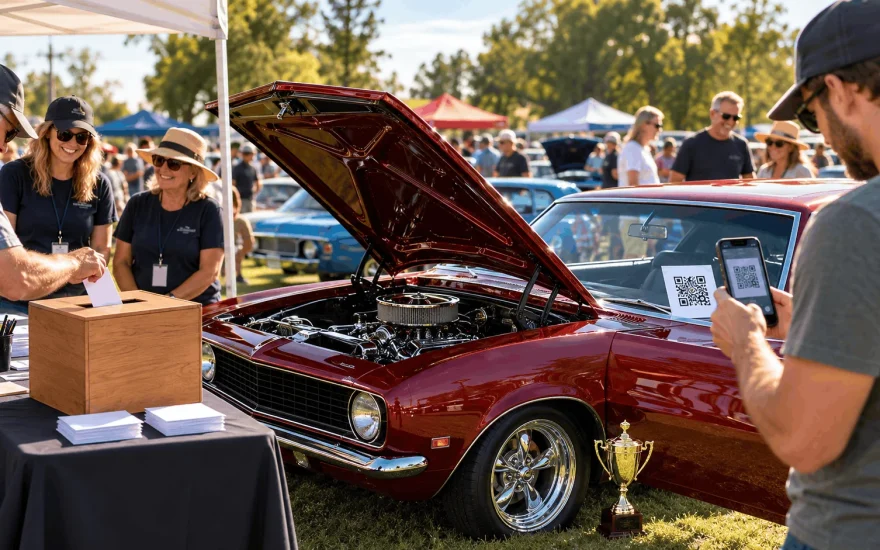
At the first, a spectator submits a free People’s Choice ballot identifying their favourite vehicle.
At the second, another visitor purchases a ticket for a chance to win a cash prize.
The first activity records a preference. The second introduces payment, a prize and chance — the features that can bring an activity within gambling legislation.
A 50/50 fundraiser is therefore not something organizers should add casually on the morning of the event.
Even a small draw may require authorization, and the eligibility requirements can depend on the organization conducting it and how proceeds will be used.
BC organizers should check charitable gaming requirements#
In British Columbia, the Independent Gambling Control Office (IGCO) administers charitable gaming event licensing.
Under the regulatory framework introduced in April 2026, the IGCO identifies three charitable gaming licence classes: Class A for eligible charitable or religious organizations, Class B for qualifying community fundraising groups, and Class C for designated fairs or exhibitions.
The applicable class depends on the applicant, the nature of the activity and the permitted use of proceeds. A community car club should not assume that being a non-profit automatically gives it unrestricted authority to conduct raffles.
The IGCO’s charitable gaming guidance and licence application information provide the current framework.
Before including a paid draw in a BC show, check:
- Whether the applicant and fundraising purpose meet the relevant eligibility requirements.
- Which licence class and raffle format apply.
- Whether a licence has been issued before the activity begins.
- What ticket, sales, advertising and winner-selection requirements apply.
- Whether an electronic raffle system requires specific approval.
- What records, financial reports and handling of proceeds are required.
The IGCO’s Licensed Charitable Gaming Event Guidance, updated April 1, 2026, distinguishes regular ticket raffles from percentage raffles such as 50/50 draws. It also sets out requirements for approved prizes, ticket procedures and electronic raffle systems.
Applications are submitted through the Gaming Online Service. The IGCO currently instructs applicants to submit at least 10 business days before the proposed event start date, while noting that this is a minimum processing allowance rather than a guarantee of approval.
British Columbia also requires participants in gambling activities, including licensed charitable raffles, to be at least 19 years old.
These are provincial requirements, not rules that automatically apply throughout Canada.
Other provinces have their own licensing authorities#
In Alberta, the Alberta Gaming, Liquor and Cannabis (AGLC) regulates charitable raffles. Its guidance identifies 50/50 draws as licensed raffle activities and explains eligibility requirements for charitable organizations.
Ontario has its own lottery-licensing framework administered through the Alcohol and Gaming Commission of Ontario and authorized municipal licensing authorities, depending on the activity.
The practical implication is straightforward: verify the rules where the draw will actually take place.
An organizer who has helped with a raffle in Alberta shouldn’t assume the same application process, eligibility requirements or licence conditions apply to a show in BC.
Keep the awards ceremony and prize draws separate#
The easiest way to avoid confusion is to give each activity its own place in the event schedule.
Judged awards should be announced from verified judging records. People’s Choice should come from the final eligible vote tally. A door prize or licensed raffle should follow its own published conditions.
A simple running order could be:
- 2:00 p.m. — Door-prize announcement: Winners selected and notified under the giveaway rules.
- 2:15 p.m. — Judged class awards: Results announced using verified vehicle numbers and class names.
- 2:30 p.m. — People’s Choice: Winner announced from the confirmed ballot tally.
- 2:40 p.m. — Licensed 50/50 draw: Conducted only if authorized, following the approved licence conditions.
These times are illustrative. Actual schedules must account for voting deadlines, judging verification and any conditions attached to a raffle licence.
The event host should receive separate results sheets. Mixing class winners, ballot totals and raffle ticket numbers on one informal list increases the chance of an announcement error.
If a winner must be present to claim a particular prize, make that condition clear before entries are accepted. Don’t impose it unexpectedly when the winning number is called.
For licensed raffles, the approved terms take precedence over an organizer’s preferred stage schedule.
A practical prize plan for a first-year show & shine#
Consider a hypothetical community show expecting 60 vehicles, a modest volunteer team and a mix of owners, families and local spectators.
The organizers want enough awards to recognize good builds without turning the afternoon into a lengthy presentation.
A manageable plan could include:
Six judged class awards. One trophy per class, with categories based on expected vehicle registration. Judges use published criteria and a consistent scoring process.
One People’s Choice award. Spectators cast a single eligible vote for their favourite vehicle, using numbered ballots or a tested digital system.
Two donated door prizes. A local automotive business provides merchandise for separate free giveaways. The organizers confirm applicable contest requirements and publish the entry and selection rules before promoting them.
An optional licensed 50/50 fundraiser. This proceeds only if the organizing group and intended use of funds qualify, the necessary licence has been issued, and volunteers are prepared to follow its conditions.
For a first-year show, leaving out the 50/50 may be the sensible decision if licensing or administration cannot be completed properly.
The event can still be worthwhile without a fundraising draw. A smoothly run show with clear judging and a welcoming atmosphere is more likely to build confidence than an overcomplicated programme of prizes.
The same principle applies to sponsorship. A business contributing a trophy doesn’t need to control the judging result, and a donated prize shouldn’t automatically become a vehicle award.
Before publishing the final event schedule, identify the selection method, eligibility rules, responsible volunteer and required documentation for every prize.
Then give each activity a name that accurately describes it.
People come to a show & shine for the vehicles, the owners and the conversations. Trophies recognize craftsmanship, People’s Choice brings spectators into the experience, and properly organized prize draws can add another reason to stay for the afternoon.
Those activities work best when their differences are clear. A fair competition should reward the qualities it claims to judge, a public vote should reflect genuine preferences, and a chance-based draw should follow the rules governing that draw. The less explaining organizers have to do after announcing a winner, the better they’ve planned the day.