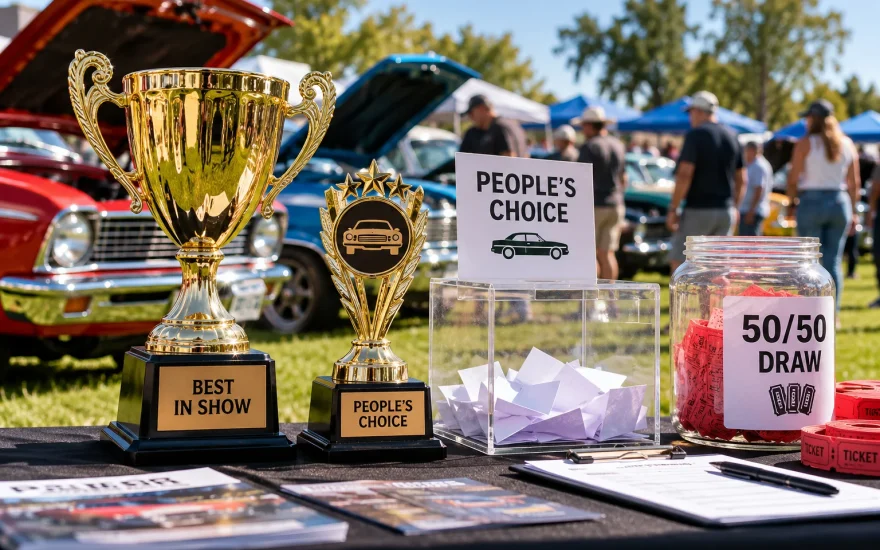
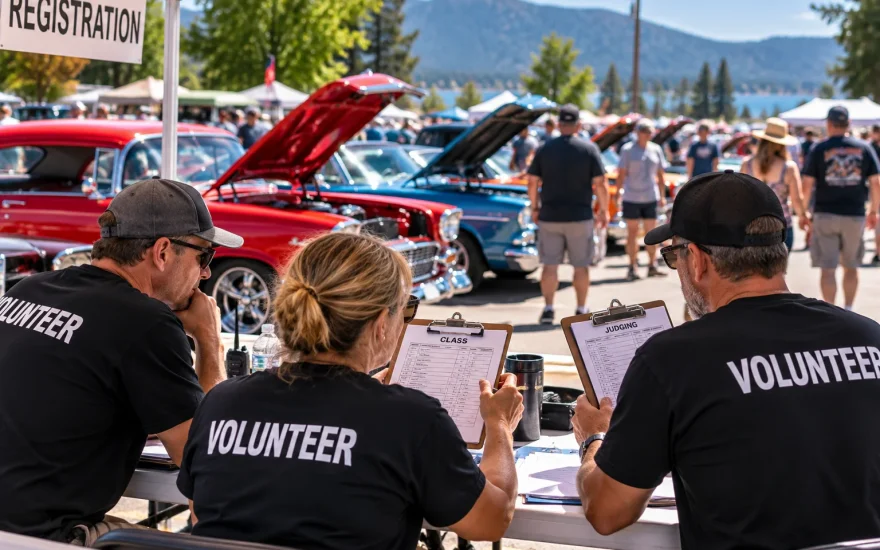
Paper Ballots vs. QR Code Voting for People’s Choice

· 14 min read
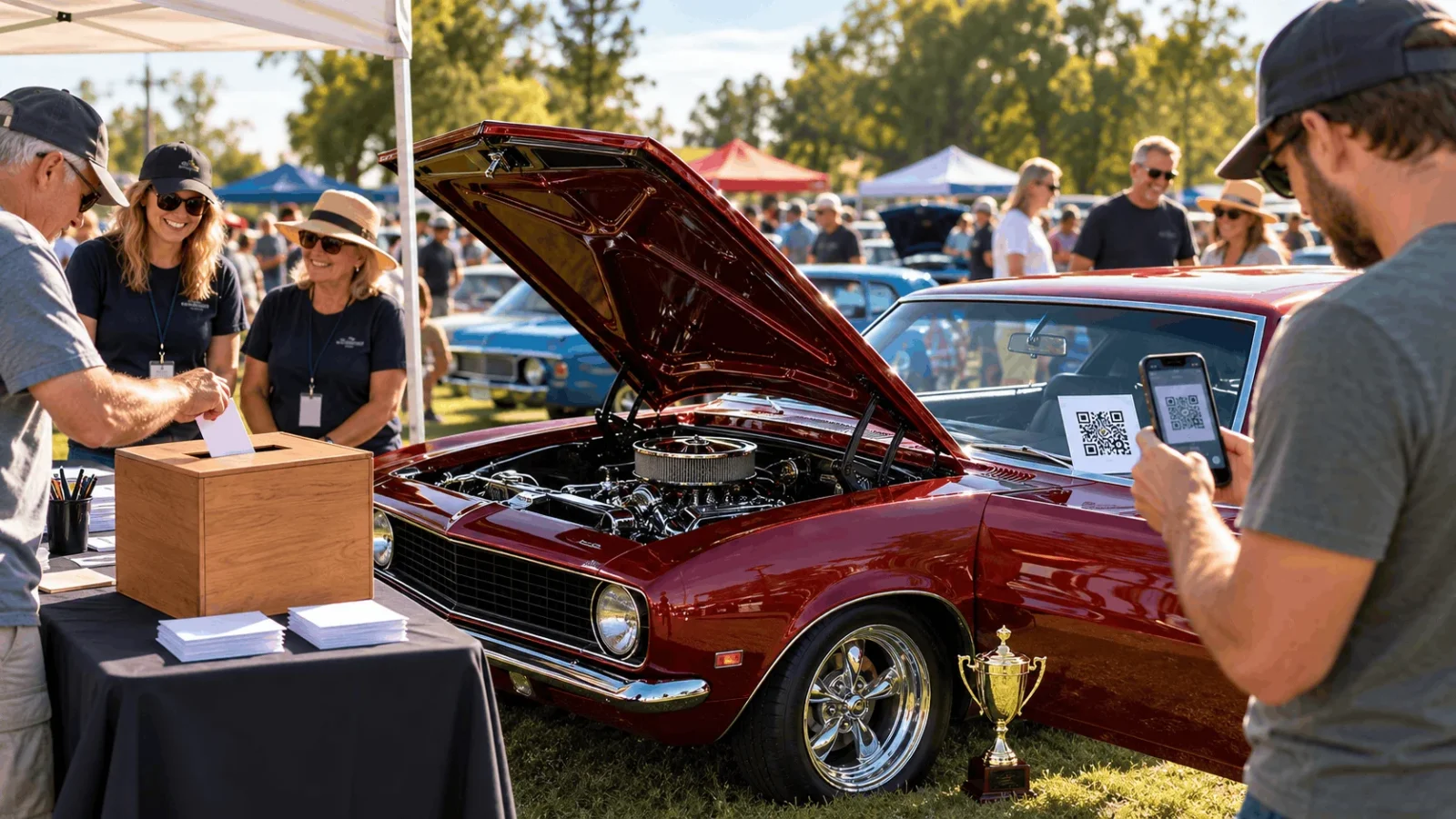
A People’s Choice award should be the easy part of a show & shine: spectators pick their favourite vehicle, the votes are counted, and someone goes home with a trophy. But a ballot box beside registration and a QR code on every windshield create very different experiences. One needs volunteers and careful counting; the other needs working phones, reliable connectivity and a system that can recognize repeat votes.
For community car shows, the best voting method isn’t necessarily the most sophisticated. It’s the one your visitors can use, your volunteers can manage and your organizers can confidently explain when the winner is announced.
Choose your voting system before you print the entry cards#
People’s Choice voting affects more than the awards ceremony. Your choice determines what goes on each vehicle’s display card, how spectators cast ballots, how volunteers help them and how results are verified.
Consider a show with 100 registered vehicles. Paper voting means every car needs a clearly visible entry number, while spectators need ballots and a place to submit them. Digital voting might use a unique QR code for each vehicle or a single event-wide ballot listing every eligible entry. A hybrid approach requires both systems to recognize the same entrants.
Changing methods after registration can create mismatched numbers, duplicate entries or voting links that point to the wrong cars.
Before choosing software or printing ballots, settle four things:
- Who gets a vote? Spectators only, registered entrants or everyone attending?
- What can they vote for? One overall People’s Choice winner or separate winners in different classes?
- How many votes are allowed? Usually one per eligible person for each published voting category.
- When does voting end? Allow enough time to verify results before the awards presentation.
Those decisions matter more than the technology.
For a small show, paper ballots can be perfectly adequate. For a larger event with hundreds of vehicles, electronic counting may save substantial volunteer time. Neither method guarantees fairness without clear rules.
Paper ballots, QR voting and hybrid systems compared#
| Method | Main advantage | Main limitation | Best use |
|---|---|---|---|
| Paper ballots | Familiar, inexpensive to organize and independent of internet access | Requires ballot control and manual counting | Smaller club meets and community shows |
| QR code voting | Convenient voting and potentially faster tallying | Depends on devices, connectivity and platform settings | Larger events with tested digital infrastructure |
| Hybrid voting | Gives spectators more ways to participate | Needs careful duplicate prevention and reconciliation | Mixed-age crowds and events with uncertain connectivity |
Paper ballots keep things familiar#
Paper works because it asks very little of visitors. Someone walks the field, chooses a vehicle, writes its number and drops the ballot into a box.
For a neighbourhood show, that simplicity is a genuine advantage. Visitors don’t need to download anything, use mobile data or create an account.
The work falls on organizers instead.
Give each registered vehicle a large, readable number. Keep the numbering consistent across windshield cards, registration records and ballots. If a participant changes parking spots, their entry number must remain the same.
At the voting station, volunteers should issue ballots according to the published eligibility rules. A ballot handed to every person without any tracking makes repeat voting easy, even if most people participate fairly.
A practical arrangement uses one clearly marked ballot box near the main information table, with another only if volunteers can supervise it. Too many collection points create extra paperwork and increase the chance of losing or double-counting ballots.
At closing time, two volunteers can work together: one reads the entries while the other records the tally. They should then reconcile the number of accepted ballots and independently check the leading candidates.
Paper voting isn’t necessarily slow. Counting 50 straightforward ballots is manageable. Sorting hundreds of handwritten entries, identifying unclear numbers and resolving invalid ballots can take much longer.
QR codes make counting easier, not automatically fairer#
A QR code can take spectators directly to a vehicle’s voting page. Some systems provide unique codes for each entrant, while others display a single event code leading to a searchable ballot.
Dedicated services such as Car Show Expert document QR-based People’s Choice voting, configurable voting categories and automatic results tallying. Their systems can also apply browser-based restrictions intended to discourage repeated votes.
That convenience comes with limitations.
A browser may recognize repeat visits through cookies or device identifiers, but clearing browser data, changing devices or using different network connections can complicate detection. IP-based controls also have trade-offs: legitimate spectators may share venue Wi-Fi or mobile network addresses.
Car Show Expert’s troubleshooting documentation specifically describes situations where shared network characteristics can temporarily prevent an otherwise legitimate voter from submitting a ballot.
A digital ballot can reduce casual duplicate voting; it shouldn’t be described as fraud-proof.
QR codes also need to remain readable. A small code behind a reflective windshield may be harder to scan than one printed on a matte display card. Test the code from the spectator’s normal viewing position, not just from a desk.
For a larger show, consider a prominent central voting station as well. Visitors should have a way to find an entrant by number if they forget where a particular car is parked.
A hybrid system needs one clear counting rule#
Combining paper and digital ballots sounds like the obvious compromise. It can improve accessibility, particularly when visitors don’t have smartphones or the mobile signal is unreliable.
But accepting both methods without a shared voter-control process creates a problem: someone can vote on their phone and submit a paper ballot too.
The easiest option is to ask each spectator to choose one voting channel, then use a common eligibility record to prevent a second submission.
For example, a volunteer might issue one anonymous voting token per eligible attendee. The token can be redeemed on paper or digitally, and the system records that it has been used without necessarily storing the person’s name.
That approach requires preparation. The paper tokens and digital platform must share a reliable way to track redemption. If they don’t, the organizer should not promise that duplicate votes can be detected across both channels.
For a small volunteer-run event, a supervised paper-assistance station may be simpler than operating two completely independent ballot systems.
Define who can vote and when voting closes#
Published voting rules protect both entrants and volunteers from last-minute arguments.
Spectators, entrants or both?#
Allowing spectators to vote creates an award based on audience preference. Allowing registered entrants to vote as well can encourage participation, but it changes the electorate.
Neither approach is inherently wrong.
If entrants can vote for their own vehicles, say so. If owners are excluded from voting, establish how that restriction will be applied. A casual statement that owners “shouldn’t vote for themselves” isn’t an enforceable rule.
For a community event, an open vote among eligible attendees is often easier to administer than a complicated distinction between vehicle owners, passengers and spectators.
Be equally clear about whether voting is limited to people physically attending the event. An unrestricted online ballot shared through social media can turn a local People’s Choice award into a contest over who has the largest online following.
Some digital platforms offer location-based restrictions, although GPS permission requirements and location errors may exclude genuine attendees. Use those restrictions only after evaluating their practical effect.
One vote per person or one vote per class?#
An overall People’s Choice award works best when everyone chooses a single favourite vehicle from the entire field.
Class-based public awards serve a different purpose. A spectator might choose one favourite classic, one favourite truck and one favourite motorcycle.
More voting categories create more work and may confuse visitors who expected to cast one ballot.
For a first-year show, one overall People’s Choice category is usually easier to explain and administer.
Before opening the ballot, decide whether it determines a standalone award or contributes to the overall results. That distinction is central to how judging and People’s Choice should work together at a community show.
A public vote should not unexpectedly override judges’ scores unless that arrangement was established in advance.
Close voting early enough to verify the result#
If awards begin at 2:30 p.m., closing voting at 2:29 p.m. leaves almost no opportunity to review the result.
For a small event, consider closing ballots 30–45 minutes before the ceremony. This is a suggested planning buffer, not an industry standard. Large paper-based events may need more time, while a tested digital system may require less.
Announce the deadline clearly and apply it consistently. Paper ballots received after closing should be handled according to the published cutoff, just as digital submissions should be disabled when voting ends.
If there is a tie, organizers need a predetermined policy. A joint award, a brief runoff or another published procedure can all work. Choosing the winner based on personal preference after seeing the results cannot.
Prevent common voting problems#
A voting system should be designed around predictable mistakes, not the assumption that everything will run perfectly.
Duplicate ballots. With paper voting, use controlled distribution, distinctive ballot stock or single-use tokens. With digital voting, review the platform’s actual anti-duplicate controls rather than relying on marketing claims. No lightweight system can guarantee one vote per human being under every circumstance.
Wrong vehicle numbers. A ballot marked “blue Mustang” may be impossible to interpret when several Mustangs attend. Require the displayed entry number and maintain a master registration list. Decide whether ambiguous ballots will be rejected before counting begins.
Weak mobile connectivity. If the digital voting page won’t load, direct spectators to an area with better reception or a staffed voting station. Don’t assume that a platform’s offline registration or check-in feature also supports offline voting.
A spectator without a smartphone. Provide an accessible alternative. A volunteer-assisted electronic ballot or supervised paper option can work, provided it follows the same eligibility and duplicate-control rules.
Disputed results. Preserve the original paper ballots or a digital results export, record any excluded votes and have a second authorized person verify the winner. Avoid displaying live rankings if doing so could encourage last-minute vote solicitation.
Accessibility matters beyond smartphone ownership. Canada’s Digital Accessibility Toolkit provides guidance on accessible online forms. Large readable labels, straightforward instructions, keyboard navigation and compatibility with assistive technology are sensible considerations when selecting a digital ballot.
Privacy deserves attention too. British Columbia’s Personal Information Protection Act applies to private-sector organizations, including many non-profits, when they handle personal information. If a voting system collects names, email addresses or other identifying information, organizers should establish a legitimate purpose, provide appropriate notice, address consent requirements and avoid collecting more than necessary.
A community car show doesn’t need to build a marketing database just to identify a favourite vehicle.
What works for a small BC community car show?#
The scale and location of the event should influence the decision more than the appeal of new technology.
Consider three hypothetical shows. These are planning examples, not accounts of actual events.
A 40-car club meet in Langley#
A local club expects a modest turnout, has several volunteers and plans a single People’s Choice award.
Recommended approach: paper ballots.
Assign every vehicle a visible number, issue one ballot per eligible attendee and place a supervised ballot box near registration. Two volunteers can verify the tally before the ceremony.
A dedicated digital platform would add setup work without necessarily improving the visitor experience.
A 100-car show & shine in Abbotsford#
The organizers expect a steady public turnout, have tested mobile reception and want results ready shortly after voting closes.
Recommended approach: QR code voting with staffed assistance.
Each car receives a readable voting code. A central information table helps visitors locate vehicles and provides support for anyone who has trouble scanning.
Before committing, organizers should verify the platform’s handling of repeat votes, shared network connections, voting deadlines and results exports.
A separate accessible voting option can be provided without automatically running an unrestricted second ballot.
A 250-vehicle outdoor event in the Fraser Valley#
The venue is spread across a large field, with uncertain cellular coverage in some areas. Spectators may move between parking rows, food vendors and shaded seating areas.
Recommended approach: a thoroughly tested hybrid system or a primarily paper-based process with enough counting volunteers.
A digital-only arrangement is risky if large parts of the site have poor connectivity.
A hybrid method makes sense only when duplicate controls can operate across both channels. Otherwise, a well-organized paper system may be more defensible, even if it requires additional tallying time.
For a larger field, organizers should also plan how ballots will be collected from distant areas without creating unsupervised voting stations.
The lesson from these scenarios isn’t that bigger shows always need digital voting. It’s that the number of cars, expected voters, volunteer capacity and reliability of the venue matter more than any single software feature.
Test the voting process before show day#
A voting method that works perfectly in the organizer’s home office may behave differently beside a row of parked vehicles.
Run a complete rehearsal using test entries, ideally at the venue.
- Verify entry numbers. Check that printed dash cards, registration records and the voting interface identify the same vehicles.
- Test QR codes on actual phones. Use different devices and browsers, including one connected through mobile data rather than venue Wi-Fi.
- Check repeat-vote behaviour. Submit a test vote, attempt another and confirm that the system responds as expected. Test shared-network conditions if those controls are used.
- Confirm the closing procedure. Make sure voting actually stops at the published deadline and that volunteers know who has authority to close it.
- Export or record the results. Check that the system produces a usable final tally, including vehicle numbers and totals.
- Rehearse the fallback. Decide what happens if the service becomes unavailable, the ballot box is damaged or an entrant’s number is missing.
Be careful when clearing digital test votes. Some systems also reset settings, judging scores or awards. Follow the platform’s instructions and remove test data before real voting begins.
For paper ballots, run a mock count with a few deliberately unclear or invalid examples. It’s much easier to agree on how to handle an incomplete ballot before one affects the winning result.
Sample People’s Choice voting rules#
The following wording can be adapted for a sign at the registration table or voting station:
PEOPLE’S CHOICE — VOTING RULES
- Voting is open to eligible event attendees, including registered entrants.
- Each eligible person may cast one vote for one vehicle.
- Vote using the vehicle’s official entry number.
- Ballots must be submitted before the announced closing time.
- Duplicate, unclear or ineligible ballots may be excluded under the event’s published procedures.
- The vehicle receiving the most valid votes wins People’s Choice.
- A tie will be resolved using the event’s announced tie-breaking procedure.
- The organizer will verify the results before announcing the winner.
If using digital voting, add concise instructions explaining how to scan and submit the ballot. If offering an alternative voting channel, explain how attendees can access it without accidentally voting twice.
Don’t publish rules that your chosen system cannot actually enforce.
A successful People’s Choice vote should feel almost invisible to the people attending. Visitors should spend their time looking at cars, comparing favourite builds and talking to owners—not troubleshooting a voting app or wondering whether their ballot counted.
Choose the method that fits the venue, explain it clearly and test the complete process before the first spectator arrives. The trophy will mean more when everyone understands how the winner was chosen.