How to Judge a Car Show and Run a Fair People’s Choice Vote

· 19 min read
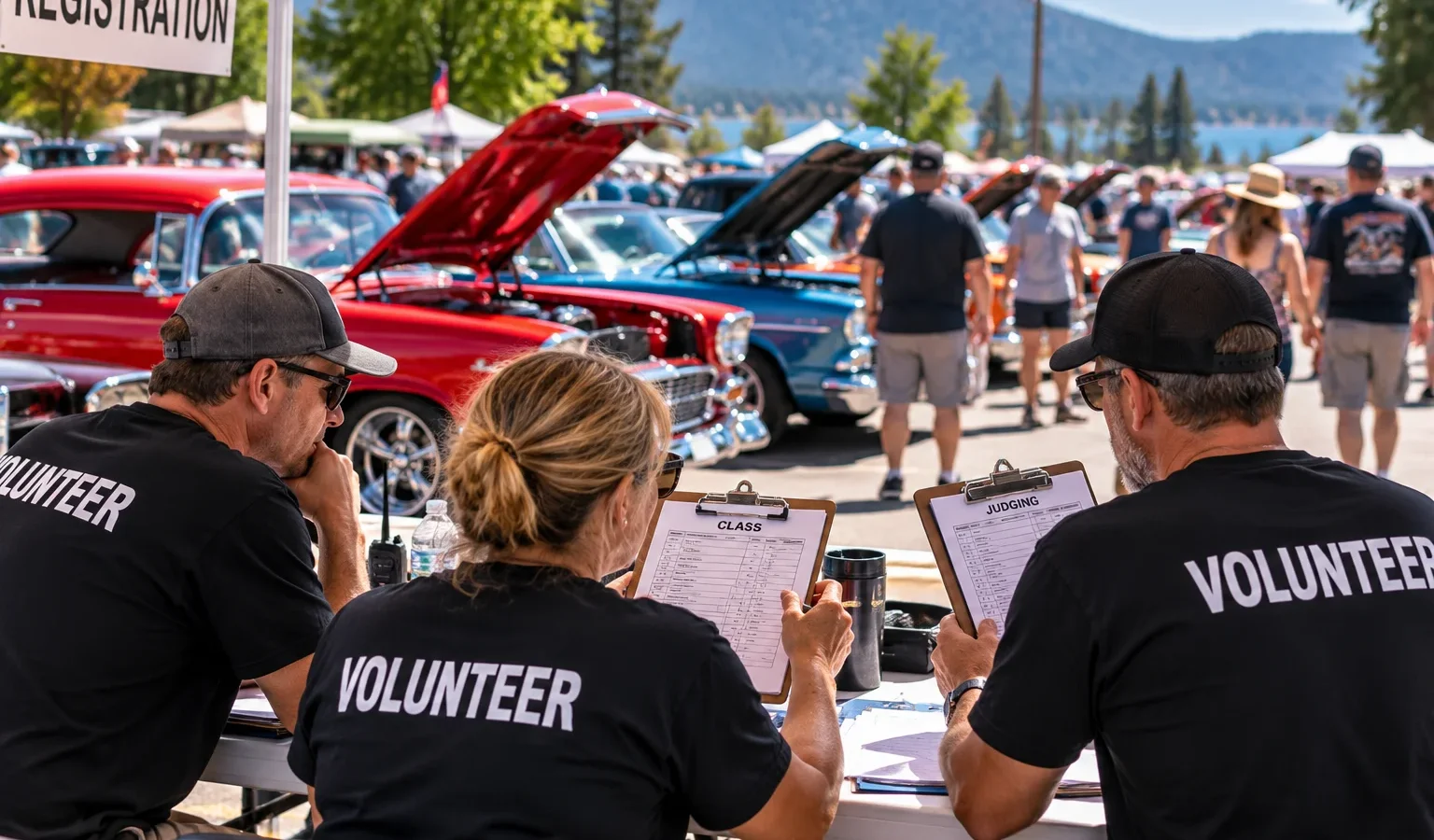
The cars are parked, the hoods are up, and the crowd is wandering between rows of polished chrome and fresh paint. Somewhere behind the registration table, three volunteers are trying to figure out whether the judging is finished, who has the last score sheet and when People’s Choice voting should close.
That’s the part of a show & shine most spectators never see — unless something goes wrong.
Fair car show judging doesn’t require a complicated scoring system or a panel of restoration experts. It requires clear classes, consistent criteria, organized volunteers and a reliable way to verify the results. Here’s how to build a judging and voting process that works from the first vehicle checking in to the final trophy presentation.
Decide what kind of competition your show will run#
Before recruiting judges or ordering trophies, decide who gets to choose the winners.
Most community car shows use one of three approaches: judged classes, People’s Choice voting or a combination of the two.
| Show format | Best suited to | Main operational need |
|---|---|---|
| Judged competition | Shows with defined vehicle classes and competitive awards | Judges, scorecards and published criteria |
| People’s Choice | Relaxed community shows focused on spectator participation | Ballots, eligibility rules and reliable counting |
| Combined format | Mid-sized shows offering both class trophies and audience awards | Separate judging and voting procedures |
Judged classes reward cars against defined criteria#
In a judged show, appointed volunteers or experienced judges evaluate vehicles against a scorecard.
Typical categories include paint and bodywork, interior condition, engine-bay presentation, cleanliness, originality and custom workmanship.
The judges aren’t simply choosing whichever car they would most like to own. They’re assessing how well each vehicle meets the expectations of its class.
A preserved 1960s classic might earn points for factory-correct components. A custom hot rod might be assessed for fabrication quality and finish. Those are different achievements, even if both vehicles look outstanding.
The National Association of Automobile Clubs of Canada (NAACC) publishes detailed guidelines illustrating how originality, restoration and vehicle classifications can shape formal collector-car judging.
A neighbourhood show & shine doesn’t need to adopt concours-level inspections, but it does need to tell entrants what judges will consider.
People’s Choice measures audience preference#
People’s Choice answers a simpler question: which vehicle did the eligible voters like best?
The winner might be a spotless restoration, a wild custom build or an ordinary vehicle with a memorable story. Public appeal doesn’t always align with technical judging.
That’s part of the attraction.
People’s Choice gives spectators a reason to explore the entire field, talk to owners and participate in the event. It also lets a car stand out without requiring specialist knowledge of restoration standards.
However, popularity creates its own challenges. An entrant with a large local following may attract more votes than a technically exceptional vehicle. Unrestricted online voting can magnify that effect.
Those outcomes aren’t necessarily unfair if the rules are transparent. They’re simply different from judged competition.
A combined show can keep the two separate#
For many community events, the simplest combined format is to let judges select the class winners while spectators choose one overall People’s Choice winner.
Consider a show with 60 vehicles divided into six classes. Judges award first place in each class. Meanwhile, visitors cast one vote for their favourite vehicle anywhere in the field.
Both competitions operate independently.
A car might win its class and People’s Choice, provided the published rules allow multiple awards. Alternatively, organizers may choose to limit how many trophies one vehicle can receive.
Avoid blending public votes into judges’ scores unless there’s a clear reason and a published formula. A loosely defined combination can make it difficult to explain why one entrant won.
Set the rules before registration opens#
Most judging disputes begin long before the awards ceremony. They’re often the result of unclear class definitions, inconsistent eligibility rules or assumptions nobody thought to put in writing.
A short, accessible set of event rules can prevent these problems.
Define eligibility and vehicle classes#
Start by establishing which vehicles may enter.
Will the event accept motorcycles? Are modern daily drivers welcome? Must a vehicle be roadworthy, or can a trailered restoration participate? Is the show open to all makes and models?
Then create classes that reflect the expected field.
A Fraser Valley community show might include classic cars, muscle cars, hot rods, modified imports, trucks and motorcycles. A marque-specific club event will need a different structure.
Avoid creating a separate trophy category for every conceivable vehicle type. A class with one entrant may make sense at a specialist gathering, but too many lightly populated classes weaken the competition at a general show.
If registration includes everything from restored classics to lifted trucks, decide how to structure car show classes and awards before assigning entrant numbers.
Publish whether classes can be combined when turnout is lower than expected. Set a deadline for final classifications and explain who has authority to resolve disputes.
Publish the awards and judging criteria#
Entrants should know what they’re competing for.
List the judged class awards, any special trophies and whether People’s Choice is separate. Define how Best in Show will be selected: highest eligible score, comparison among class winners or a dedicated final judging round.
Also explain whether a vehicle can receive multiple awards.
Don’t advertise Best Original and then judge every entry primarily on paint gloss. Don’t create a custom category while penalizing extensive modifications simply because they’re not factory-correct.
The judging criteria should match the award’s stated purpose.
Explain how entrants can ask for clarification#
Give owners a straightforward way to question their classification or report an administrative mistake.
Before judging begins, the registration coordinator can review a disputed class assignment against the published rules. During judging, questions about scoring procedures should go to the head judge rather than individual volunteers.
This doesn’t require a formal appeals tribunal. It requires one designated decision-maker and a consistent process.
Keep a brief record of changes so the registration list, score sheets and award results remain aligned.
Build a scoring system judges can actually use#
A scorecard should be detailed enough to produce meaningful comparisons but short enough for volunteers to complete consistently.
At a casual show, a five-category system worth 50 points is a reasonable starting point.
For example, organizers might allocate 10 points each to paint and bodywork, interior, engine bay, wheels and overall presentation, and build quality or originality.
Those weights are editorial examples, not official Canadian standards. A preservation event might place greater weight on authenticity. A custom show might emphasize fabrication and execution.
Score condition, presentation and build quality consistently#
Judges need shared definitions for what constitutes an average, strong or exceptional score.
Without guidance, one judge may consider 8/10 excellent while another rarely awards anything below 9/10.
A short briefing should establish examples:
- Condition: Are paint defects, worn upholstery and damaged trim evaluated consistently?
- Cleanliness: Does road dust affect the score, and is ordinary age treated differently from neglect?
- Presentation: Are judges evaluating the car itself rather than the value of display props?
- Workmanship: Does the installation look carefully executed, regardless of how expensive the components are?
A practical car show judging sheet should give volunteers enough direction to score consistently without turning a relaxed community show into a lengthy inspection.
The 50-point judging sheet and scoring guide provides a usable template and examples of how individual category scores can be interpreted.
Adapt judging to stock and modified cars#
A vehicle shouldn’t be penalized for doing exactly what its class encourages.
An original classic may deserve recognition for authentic materials and preserved components, even if its finish shows age. A modified import may deserve recognition for clean fabrication and carefully integrated upgrades.
That distinction should be reflected in the judging instructions.
Where the differences are substantial, use class-specific criteria. Motorcycles, for example, shouldn’t be assessed using car-specific interior categories.
If different classes use different scoring systems, don’t automatically compare their raw totals to determine Best in Show. A separate final assessment may be fairer.
Define tie-breakers before the first car is judged#
Suppose two vehicles finish with 44 out of 50 points.
Entry 12 scores higher for paint and bodywork, while Entry 37 scores higher for build quality.
Which wins?
The answer should already be in the rules.
Organizers might use the higher paint score as the first tie-breaker, followed by build quality and then an independent head-judge review.
A restoration-focused show could reasonably prioritize originality instead.
Neither approach is inherently correct. Choosing a tie-breaker after seeing the results is the problem.
Recruit judges and plan the inspection schedule#
The number of judges you need depends on vehicle count, inspection time and whether judges work independently or as a team.
A carefully planned schedule matters more than simply recruiting as many volunteers as possible.
How many volunteers will you need?#
Consider a hypothetical 60-car show.
If each assessment takes four minutes, the basic workload is:
60 vehicles × 4 minutes = 240 judge-minutes.
With three judges each assigned 20 vehicles, that represents approximately 80 minutes of judging per person, excluding walking, interruptions and paperwork.
This is a planning calculation, not an established industry benchmark.
If all three judges independently score every vehicle, the workload increases to 720 judge-minutes. The organizer must account for that difference.
For a small event, a practical staffing arrangement might include:
- Three judges responsible for assigned vehicles or classes.
- One head judge overseeing criteria, disputes and missing assessments.
- Two registration volunteers managing entrant records and vehicle numbers.
- Two voting volunteers handling People’s Choice ballots.
- One results coordinator checking totals and preparing winners’ information.
These are roles, not necessarily nine separate people. Some volunteers can change responsibilities as the event progresses, provided conflicting duties don’t overlap.
The results coordinator should have enough uninterrupted time to verify scores before awards.
Brief judges and manage conflicts of interest#
Hold a short judges’ meeting before inspections begin.
Explain the scoring scale, inspection boundaries, class assignments, tie-breakers and deadline for completed sheets.
Use one example vehicle to compare scoring interpretations. If judges disagree significantly about what merits 7/10 versus 9/10, clarify the expectations before they spread across the field.
Local car communities are close-knit. A judge might know an entrant or have helped work on a vehicle. Ask volunteers to disclose meaningful connections and reassign those assessments where possible.
Record substitutions rather than allowing informal exchanges between judges.
Keep entrants informed while judging takes place#
Owners should know approximately when judging will happen and whether they need to remain with their vehicles.
If judges require the hood or trunk open, communicate that before the inspection window. Never assume volunteers can touch or open a vehicle without permission.
For outdoor shows, judges should also avoid creating congestion around moving vehicles or blocking pedestrian routes.
An unattended car, inaccessible engine bay or missing entry number needs a predefined procedure. Don’t leave individual judges to invent different penalties.
Run People’s Choice without losing control of the ballot#
People’s Choice is easy to explain but can become difficult to administer when voting rules are vague.
Decide whether spectators, registered entrants or both are eligible. Establish how many votes each person may cast, whether voting is restricted to people attending the event and when ballots close.
An overall People’s Choice award is often simpler than asking visitors to vote in every vehicle class.
Choose paper, QR or hybrid voting#
Paper ballots work particularly well at smaller shows. Visitors write an entry number and deposit the ballot in a supervised box.
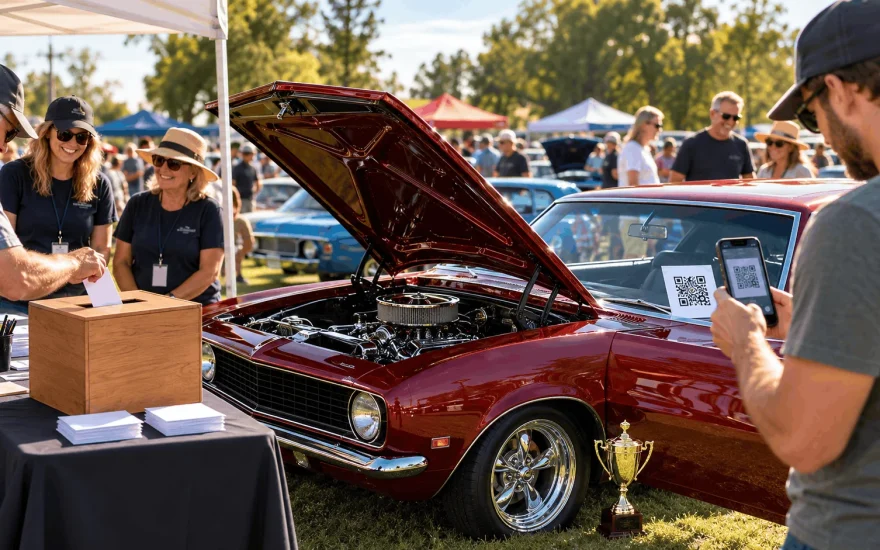
Digital voting can simplify counting, especially when a large number of visitors participate. QR codes placed on vehicle information cards can lead to individual voting pages or a central event ballot.
A hybrid system accommodates visitors who don’t have smartphones or encounter connectivity problems.
Each method has trade-offs.
Paper requires volunteers to distribute and count ballots. Digital voting depends on phones, network access and platform controls. Hybrid voting needs a reliable way to prevent someone from voting through both channels.
The right ballot depends on your audience and venue, so compare paper, QR and hybrid voting options before committing to a system.
Prevent duplicate votes without excluding genuine visitors#
Don’t confuse technical restrictions with guaranteed fraud prevention.
A voting platform may use cookies, device identifiers or network information to discourage repeat submissions. Those controls have limitations, especially when several spectators share public Wi-Fi or mobile network infrastructure.
Paper ballots face different risks, including repeated submissions and illegible entry numbers.
Choose a proportionate approach: controlled ballot distribution, single-use voting tokens or digital eligibility checks where practical.
Keep the rules understandable. A neighbourhood event shouldn’t require spectators to surrender unnecessary personal information simply to vote for a favourite car.
Make voting accessible to the whole crowd#
A spectator without a smartphone should still have a reasonable way to participate if the event promotes an open public vote.
A supervised paper alternative or volunteer-assisted voting station may solve the problem.
Digital ballots should use readable text, clear instructions and accessible forms. QR codes need sufficient contrast and should be positioned where visitors can scan them comfortably.
For an outdoor BC show, test mobile connectivity across the actual venue. Reception near the registration tent doesn’t guarantee it will work at the far end of a large field.
Build a realistic judging-day timeline#
The judging schedule should work backwards from the awards ceremony.
If trophies are due at 2:30 p.m., results need to be confirmed well before then. Volunteers must have time to resolve incomplete score sheets, count ballots and prepare the announcements.
The following is a hypothetical schedule for a 60-car community show, not a timetable taken from a specific event.
| Time | Activity | Responsible |
|---|---|---|
| 8:00 a.m. | Registration and vehicle check-in | Registration team |
| 9:30 a.m. | Judges’ briefing | Head judge |
| 10:00 a.m. | Class judging begins | Judging teams |
| 11:00 a.m. | People’s Choice voting opens | Voting team |
| 1:30 p.m. | Voting closes | Voting coordinator |
| 2:00 p.m. | Final results verified | Head judge and results coordinator |
| 2:30 p.m. | Awards presentation | Event host |
Judged classes and public voting can overlap because they serve separate purposes.
However, don’t schedule every operational deadline for the same moment. Judges may still be checking a difficult class while voting volunteers are handling the last ballots.
Create a clear cutoff for judging sheets, with time reserved for missing scores and corrections.
Plan for late arrivals and weather changes#
Late entrants can disrupt class assignments, especially when categories have few vehicles.
Set a registration cutoff for judged competition. You may still welcome later arrivals for display if venue arrangements permit, but their eligibility for trophies should follow the published policy.
Weather is another practical concern. A Fraser Valley summer show may start dry and encounter rain before judging finishes.
If conditions become unsafe, suspend inspections and move volunteers to shelter. Protect paper score sheets and electronic equipment from moisture.
Avoid changing scoring criteria because one vehicle was inspected in sunshine and another during rainfall. If weather materially affects the process, the head judge should document a consistent solution.
For events occupying or affecting a provincial public highway in British Columbia, organizers may also need a highway-use permit and associated arrangements. The BC government’s special-event guidance specifically includes car shows and explains when provincial highway approval is required. Requirements for municipal streets, parks or private venues must be checked with the relevant authority.
Those arrangements belong in the wider event plan, alongside safe pedestrian routes, parking management and accessible facilities.
Verify results before announcing winners#
The final results check is where an orderly judging process proves its value.
A trophy announcement should never depend on an unchecked spreadsheet total or a verbal estimate from someone counting ballots behind the registration tent.
Check score totals and missing judging sheets#
Before confirming winners, the results coordinator should reconcile the judged entries with the registration list.
Check that:
- Every eligible vehicle has the required number of assessments.
- All scores fall within the permitted range.
- Category totals and overall scores have been calculated correctly.
- Vehicles are assigned to the correct classes.
- Withdrawn or ineligible entries have been handled according to the rules.
- Tied results have been identified for review.
A second authorized person should verify class winners and special awards.
If several judges score the same vehicle, confirm whether the published method uses an average, combined total or another aggregation formula. Mixing calculation methods creates misleading rankings.
Resolve ties and voting disputes#
Imagine two classic cars receive identical top scores.
The head judge applies the previously published tie-breaker, records the result and signs off on the class.
Now consider a separate People’s Choice dispute.
A digital tally shows Entry 24 leading by three votes, but organizers discover several repeated submissions that the platform flagged.
Rather than automatically removing votes based on suspicion, the voting coordinator should review the available records against the published eligibility and duplicate-vote policy. Any exclusions should be documented, and the adjusted tally independently checked.
If the evidence doesn’t support a reliable distinction between valid and invalid votes, organizers should use their preannounced dispute procedure instead of inventing a new rule.
The goal is a defensible decision, not necessarily a result everyone likes.
Keep judged awards separate from random draws#
Some community car shows also offer door prizes or charity fundraising draws.
Those activities shouldn’t be confused with vehicle awards.
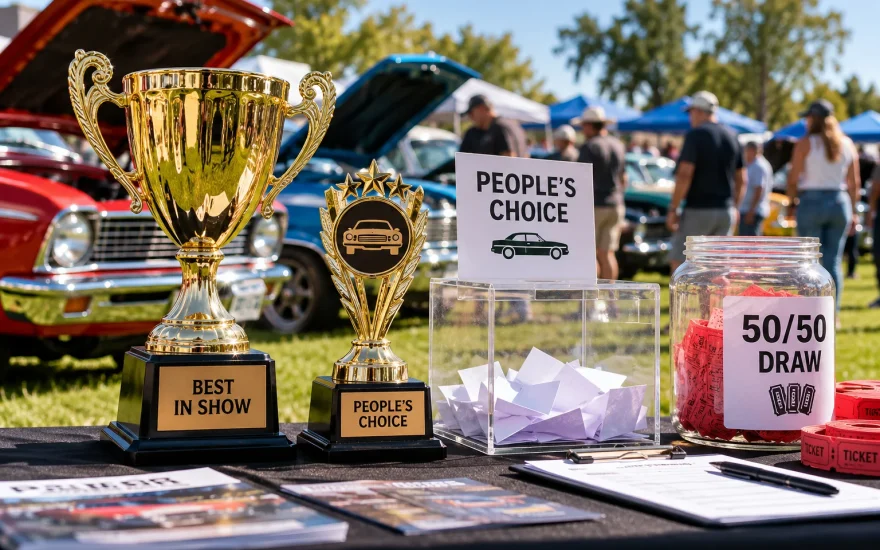
Judges’ Choice recognizes vehicles against scoring criteria. People’s Choice reflects eligible public votes. A random prize draw selects a participant through an entirely different mechanism.
Before the awards ceremony, make sure the team understands the differences between judged awards, public votes and prize draws, particularly when a fundraiser or door-prize drawing is also on the schedule.
A paid 50/50 raffle can involve provincial charitable gaming requirements. In British Columbia, organizers should consult the applicable government gaming guidance rather than assuming the rules for a free public ballot also apply to a fundraising draw.
Keep draw records and vehicle judging results separate so the audience understands how each winner was selected.
Announce awards without creating confusion#
An awards ceremony should feel like the payoff for a good day, not another administrative challenge.
Prepare a verified winners’ sheet for the event host. Each entry should include the award name, vehicle number, owner’s name where appropriate, and year, make and model.
Check spelling and pronunciation before the presentation.
Organize trophies in the order they’ll be awarded. A volunteer should track which awards have been collected, particularly if winners are away from their vehicles when called.
For larger events, announcing the class before the winning vehicle gives participants time to follow the results.
If an owner isn’t present, establish whether the trophy will be held for collection or passed to an authorized representative.
Avoid changing award names at the last minute. If the advertised category was Best Modified Truck, announcing Best Custom Truck may cause confusion about eligibility and results.
After the ceremony, publish the confirmed winners through the club’s normal channels. Vehicle numbers, award categories and vehicle descriptions are usually sufficient for a useful public record. Handle owners’ personal information according to what was collected and disclosed for the event.
A short acknowledgement of judges, volunteers, sponsors and participants belongs here too. The trophies matter, but so does the community that brought the cars together.
What to change before next year’s show#
Once the field has emptied, the judging records become useful planning material.
Compare expected attendance with actual entries. Identify classes that were overcrowded or nearly empty. Review whether judges completed their assignments on schedule and whether the voting system caused confusion.
Keep a short record of specific problems:
- Were entry numbers difficult to read?
- Did judges interpret any scoring category differently?
- Did class changes delay inspections?
- Were ballots received after the closing time?
- Did poor connectivity prevent spectators from voting?
- Were there enough volunteers to verify results without rushing?
Separate genuine procedural problems from disappointment with individual results. An entrant disagreeing with a score doesn’t necessarily mean the process failed, but several judges misunderstanding the same criterion indicates something worth fixing.
For a recurring show, these notes help establish realistic staffing, class structures and judging windows. They also reduce the amount of guesswork required by next year’s organizing committee.
A useful final step is to prepare a one-page judging plan for the next event. It should identify the competition format, vehicle classes, scorecard, judges, inspection window, voting rules, tie-breakers, results coordinator and awards time.
Keep that page alongside the registration records and volunteer assignments.
A well-run show & shine doesn’t need judging to dominate the day. Owners should be able to display their vehicles, spectators should enjoy the cars, and volunteers should know exactly what they’re responsible for. When the rules are clear and the results can be explained, the competition adds something worthwhile to the gathering — without getting in the way of everything that makes car shows enjoyable.