How to Create a Fair Car Show Judging Sheet

· 12 min read
A judging sheet can make or break the awards at a community show & shine. When judges have different ideas about what deserves a perfect score, even a well-organized event can end with frustrated entrants and disputed trophies. A simple 50-point scorecard, clear judging criteria and a few ground rules give volunteers a consistent way to evaluate everything from restored classics to custom-built trucks.
The goal isn’t to turn a Saturday car show into a concours d’elegance. It’s to make sure every vehicle gets a fair look, the scores mean something and the winners can be announced on time.
Start with the kind of show you’re judging#
Before assigning points, decide what your event is actually celebrating.
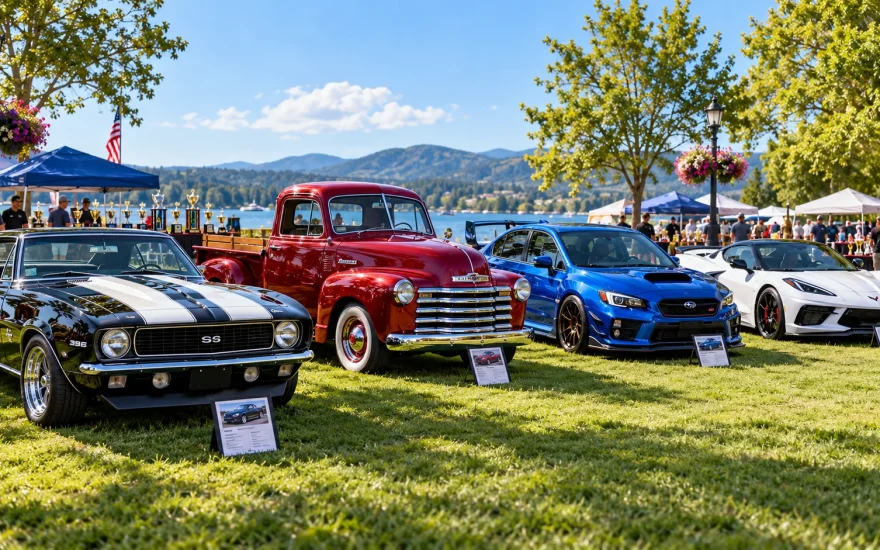
A restoration-focused club meet might reward factory-correct components and period-appropriate finishes. A hot rod show will care more about fabrication, design and execution. At a community show & shine in the Fraser Valley, those vehicles might be parked alongside daily drivers, motorcycles and lifted pickups.
One scorecard won’t necessarily judge all of them fairly.
A neighbourhood show & shine needs a simpler scorecard#
For a casual event, concentrate on qualities judges can reasonably observe while walking around a parked vehicle: cleanliness, condition, finish quality, workmanship and overall presentation.
A five-category sheet is usually easier for volunteer judges to apply than a detailed restoration checklist. It also avoids requiring specialist knowledge of every vehicle’s original specifications.
Make the scope clear. If you’re running an appearance competition, judges shouldn’t need to verify matching engine numbers or inspect factory production records unless those requirements were announced in advance.
Judge originality and custom work differently#
Imagine a carefully preserved 1967 Mustang parked beside a modified 1990s Honda Civic.
The Mustang might deserve recognition for retaining original components and period-correct details. The Civic might deserve recognition for clean fabrication, carefully routed wiring and a well-executed engine swap.
Penalizing the Civic for lacking factory parts would miss the point of its build. Rewarding the Mustang for expensive modern modifications would make equally little sense in an originality class.
The fairest approach is to keep the main scoring areas consistent while defining the final category according to the vehicle’s class.
A practical 50-point judging sheet#
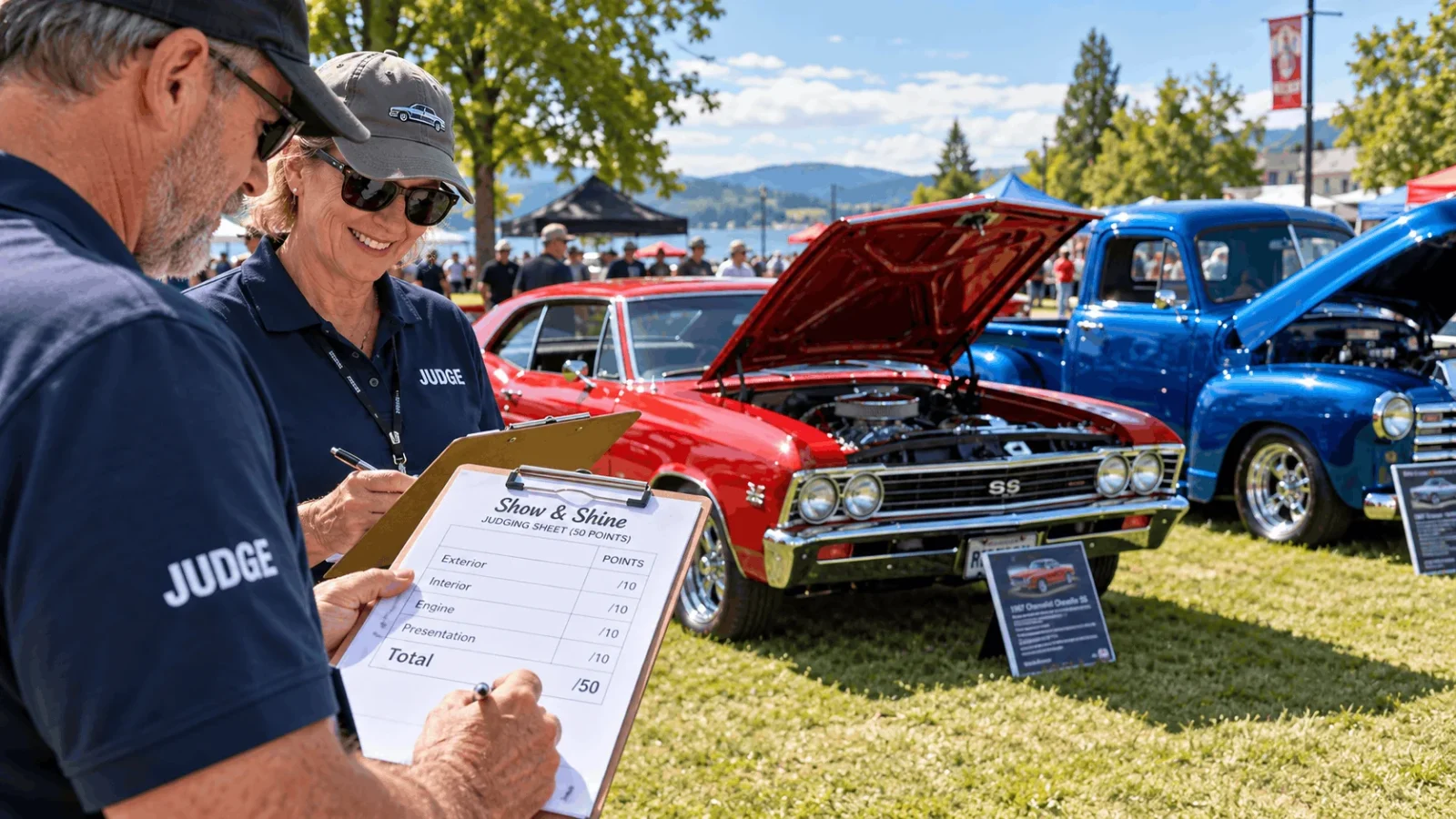
For a small or mid-sized community show, five categories worth 10 points each provide a straightforward starting point.
The scorecard below is an editorial template, not an official Canadian judging standard. Organizers can adapt it to their event, provided they publish the criteria and apply them consistently within each class.
Printable Show & Shine judging scorecard#
Event: __________________________
Date: ___________________________
Entry number: ___________________
Vehicle class: ___________________
Year / Make / Model: __________________________
Judge: __________________________
| Judging category | Maximum points | Score |
|---|---|---|
| Paint and bodywork | 10 | _____ |
| Interior condition | 10 | _____ |
| Engine bay | 10 | _____ |
| Wheels and overall presentation | 10 | _____ |
| Build quality or originality | 10 | _____ |
| Total | 50 | _____ |
Strongest detail: __________________________
Area for improvement: __________________________
Tie-breaker notes: __________________________
Head judge review required: Yes / No
Each category should have a defined purpose.
Paint and bodywork covers paint condition, gloss, finish consistency, panel alignment, chrome, exterior trim and visible defects. A high score should reflect careful preparation and workmanship, not simply an expensive paint job.
Interior condition covers upholstery, carpets, dashboard, trim, cleanliness and the quality of visible restoration or customization. Normal wear may be acceptable in a preservation class.
Engine bay covers visible cleanliness, installation quality, hoses, wiring and presentation. Judges should assess only what they can safely see.
Wheels and overall presentation covers wheels, tires, visible fitment, stance and how the vehicle presents as a complete display. A tidy information card can help, but elaborate props shouldn’t compensate for poor vehicle condition.
Build quality or originality changes with the class. Stock and restored vehicles are assessed against the class’s authenticity expectations; modified vehicles are assessed for execution, consistency and craftsmanship.
Define what each score actually means#
A number without an explanation is just an opinion.
Before judging begins, give volunteers shared reference points for the 0–10 scale.
| Score | Suggested interpretation |
|---|---|
| 0–2 | Major visible deficiencies, incomplete work or substantial deterioration |
| 3–4 | Several obvious problems affecting condition or presentation |
| 5–6 | Presentable, with noticeable imperfections or unfinished details |
| 7–8 | Very good condition or workmanship, with minor imperfections |
| 9–10 | Outstanding condition or execution for the class, with little to criticize |
Consider a well-kept pickup with clean paint, a few stone chips and one noticeable swirl-marked panel. An 8/10 for paint might be reasonable. A heavily oxidized hood, mismatched repair and multiple damaged panels would justify a substantially lower score.
A 10 should mean excellent against the published criteria, not necessarily better than every other vehicle at the show.
Judges should be able to explain what prevented a higher score. A note such as “paint haze on hood” is more useful than “needs work.”
Decide what judges may inspect#
Your judging policy should state whether hoods, doors and trunks need to be open.
At a casual outdoor show, inspections should generally be visual. Judges shouldn’t open doors, lift hoods, move accessories or touch expensive finishes without the owner’s permission.
If engine-bay access is required for scoring, tell entrants before the event. For a vehicle whose hood cannot be opened, decide beforehand whether the category is marked as not assessed, scored as displayed or handled through an alternative procedure. Never improvise a penalty halfway through judging.
The same principle applies to underside inspections. Unless your event specifically provides for them, don’t expect volunteers to crawl beneath vehicles or ask owners to raise cars in crowded display areas.
Match the scorecard to different vehicle classes#
A single 50-point form works when vehicles have comparable judging priorities. Separate class-specific instructions are better when the meaning of a category changes substantially.
For original or unrestored vehicles, preservation matters. Factory finishes, appropriate components and authentic wear may deserve recognition. A beautifully preserved original shouldn’t automatically lose to a fresh restoration simply because its paint has decades of patina.
For restored classics, examine the standard of restoration, period-appropriate details, fit and finish. Documentation can clarify authenticity, but shouldn’t become an unannounced requirement.
For custom builds, focus on fabrication quality, wiring, interior craftsmanship, fitment and how consistently the modifications work together. A professionally integrated engine swap may score well even though it’s far from stock.
For trucks, retain the same basic areas but consider practical differences in bodywork, beds, suspension presentation and equipment. A restored work truck and a heavily lifted custom truck may require separate classes.
For motorcycles, use a different sheet rather than forcing car-specific interior and bodywork categories onto a bike. Suitable areas could include paint and finish, visible mechanical components, controls, wheels, detailing and overall workmanship.
There’s also a useful distinction between a survivor and a neglected vehicle. Original paint with honest age and careful preservation can be valuable in a survivor class; dirty surfaces and poor maintenance don’t automatically become desirable patina.
Publish any adjusted scoring criteria before judging starts. If a motorcycle is evaluated on one 50-point sheet and a car on another, those totals shouldn’t automatically be treated as directly comparable for Best in Show.
Keep judging consistent when volunteers are involved#
A good judging system depends as much on the people holding the clipboards as on the form itself.
Give judges a short briefing before the show#
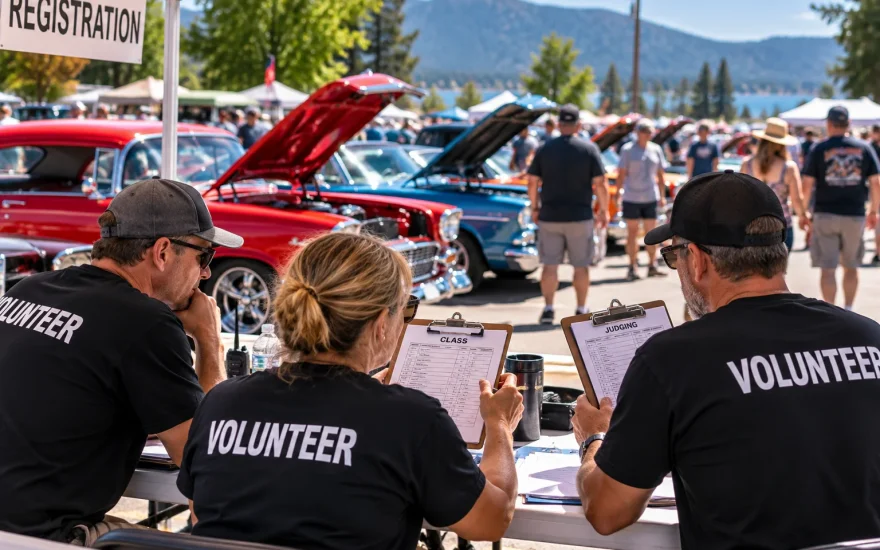
A 10–15-minute briefing can prevent considerable disagreement later.
Use two hypothetical vehicles to discuss how the scorecard should work. Ask judges questions such as:
- Does a polished custom engine bay score differently from an original factory-correct bay?
- How should we treat minor wear on an unrestored classic?
- Are we evaluating the vehicle itself or its display accessories?
- What happens when an owner is absent and an inspection area is closed?
Have each judge score the same example independently, then compare the results. If one assigns 5/10 for paint and another assigns 9/10, clarify the standard before they start assessing entrants.
Judges don’t need identical opinions, but they should be applying the same criteria.
Avoid conflicts of interest#
Local car communities are close-knit. A volunteer may know several owners, belong to the same club or have helped restore one of the vehicles.
That isn’t unusual, but it needs a process.
Ask judges to declare meaningful connections before assignments are made. Someone who owns, substantially worked on or has a significant personal interest in an entrant’s vehicle should not score it.
Assign a different judge where possible and document the substitution.
A scorecard is only one part of a fair event. The complete car show judging and voting process also needs clear class assignments, ballot rules and a plan for announcing winners.
Set a tie-breaker before judging begins#
Suppose two vehicles both finish with 44/50:
- Entry 18: Paint 10, Interior 8, Engine 9, Presentation 9, Build 8.
- Entry 42: Paint 9, Interior 9, Engine 8, Presentation 9, Build 9.
If your published first tie-breaker is the higher paint-and-bodywork score, Entry 18 wins. If the higher build-quality score is the first tie-breaker, Entry 42 wins.
Neither method is inherently correct. The problem arises when the head judge chooses a preferred category only after seeing the tied results.
A workable order might be:
- Higher paint-and-bodywork score.
- Higher build-quality or originality score.
- Independent review by a designated head judge if the tie remains.
Use the same procedure for every eligible vehicle in the class. For classes emphasizing originality or preservation, you may choose a different priority, but publish it beforehand.
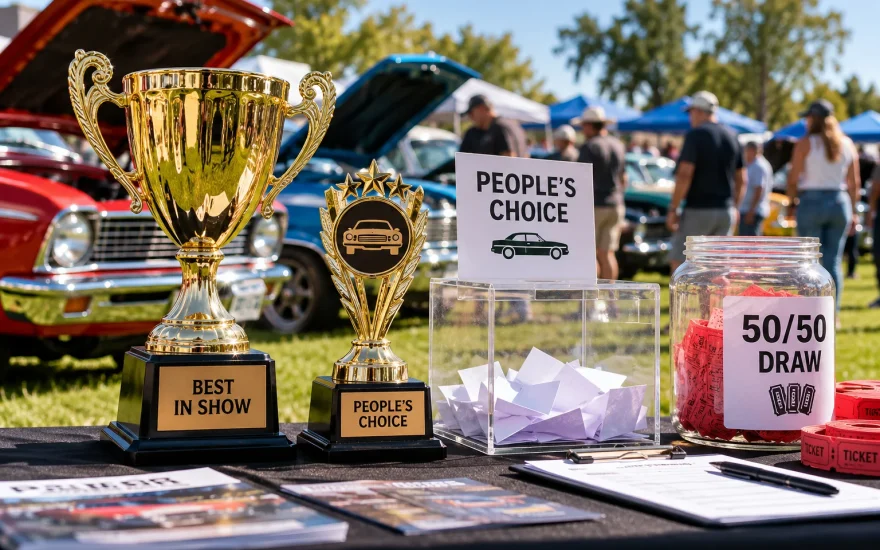
Keep People’s Choice separate unless the event rules explicitly say otherwise. A public popularity vote shouldn’t unexpectedly overturn a judged class result.
How many judges do you need?#
Start with the number of vehicles, the time required per inspection and the judging window.
For a show expecting 60 vehicles, assume each inspection takes approximately four minutes. This is a planning estimate, not an established judging standard.
The basic calculation is:
60 vehicles × 4 minutes = 240 judge-minutes
With three judges dividing the entries evenly:
240 judge-minutes ÷ 3 judges = 80 minutes
That’s the ideal calculation. Real events have interruptions: an entrant is chatting with spectators, a hood needs opening, a judge needs clarification or the next vehicle is parked across the field.
Build extra time into the schedule, along with a separate period for checking score totals and resolving ties.
One important distinction: three judges each evaluating 20 cars is not the same as three judges independently evaluating all 60. The second method triples the number of assessments, although teams can still work concurrently. Decide which approach you’re using before estimating the schedule.
At a larger event, dividing judges by area of expertise can improve consistency. One person might assess exteriors while another examines interiors. However, that system requires each vehicle to receive all its assigned category scores and needs a reliable way to combine the sheets.
For a first-year community show with limited volunteers, a simpler approach often wins: assign each judge a manageable set of vehicles, use the same form and have the head judge review the leading scores.
Print, test and finalize your scorecard#
The night before the show isn’t the time to discover that your scoring form has no entry-number field or that nobody knows who collects the finished sheets.
Run through the full process before printing the final batch.
First, test two example vehicles. Use contrasting cases, such as a preserved classic and a modified import. Score them using the proposed criteria and identify any wording that produces inconsistent interpretations.
Second, check the paperwork. Every form needs an entry number, vehicle class, judge identification, individual scores, total and space for notes. If you allow a category to be marked not applicable, establish how the final score will be calculated.
Third, decide how scores will be collected. A central volunteer can check each sheet for missing marks, enter totals into a spreadsheet and flag tied results. Ideally, that person should not be responsible for judging vehicles at the same time.
Fourth, prepare for weather. British Columbia show & shines may encounter drizzle, wind or a hot afternoon even during the main summer season. Clipboards, waterproof folders, spare pens and a sheltered tallying area are inexpensive safeguards against damaged or missing forms.
Finally, print extras. Keep blank sheets, the scoring definitions and the tie-breaker policy together at registration or judging headquarters.
Don’t change the scorecard after judging begins unless a genuine procedural problem makes it unavoidable. Any change should be documented and applied consistently to affected entries.
A good judging sheet doesn’t guarantee everyone will agree with the trophy results. It does something more useful: it gives volunteers a clear method, gives entrants a fair basis for comparison and gives organizers a result they can explain.
Before opening registration, make sure you can answer three questions: What are we judging, what earns the points, and how will we settle a tie? If the answers fit on the same page as your scorecard, you’ve probably built a system suitable for a community show & shine.